
Services
What are Guided Injections?
Injections are a valuable tool in the management of many foot and ankle conditions. Depending on the type of injection used, they can reduce inflammation, break down scar tissue, decompress irritated nerves, or provide targeted pain relief. Importantly, they also play a key role in the diagnostic process — a well-placed injection that relieves your pain, even temporarily, can confirm that a specific structure is the source of your symptoms and help guide future treatment decisions.
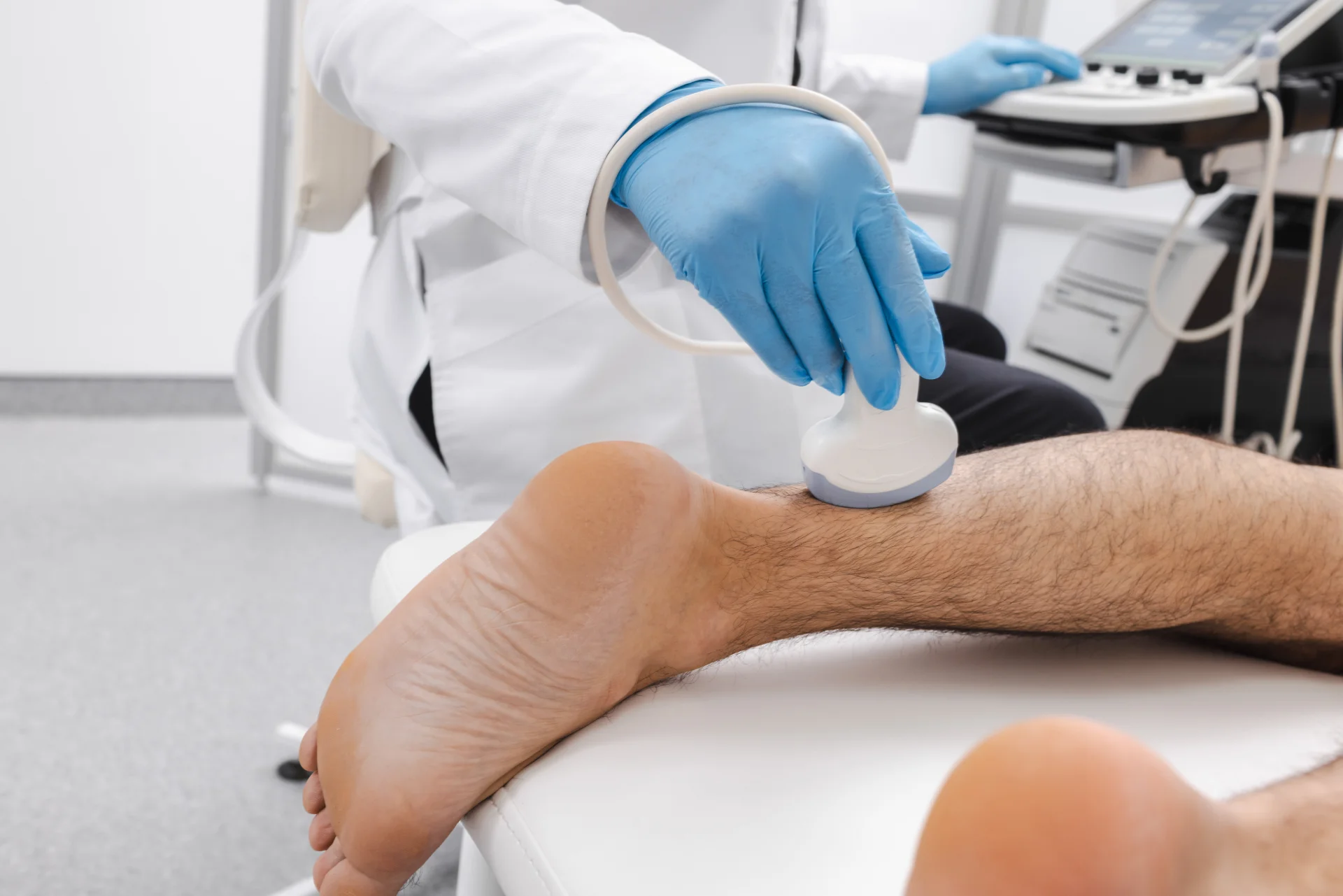
All injections are carried out with precision, and where appropriate, ultrasound or xray guidance is used to ensure accurate placement. The procedure itself is usually quick, and whilst some patients experience brief discomfort at the time, most find it very well tolerated.

Types of Injection
- Corticosteroid Injections – are powerful anti-inflammatory agents. When injected directly into or around an affected joint, tendon sheath, or nerve, they can significantly reduce swelling, pain, and irritation. Relief can last from several weeks to several months and is often sufficient to allow rehabilitation or avoid the need for surgery altogether.
They also serve an important diagnostic purpose — if an injection into a specific joint or soft tissue structure produces a clear improvement in your symptoms, this tells us that structure is the primary source of your pain, which is invaluable when planning further treatment.
- High Volume Injections – deliver a larger quantity of fluid — typically a combination of saline, local anaesthetic, and sometimes a small amount of corticosteroid — into a precise location under ultrasound guidance. The mechanical effect of the fluid is thought to disrupt pathological neovascularisation (abnormal new blood vessel ingrowth) and break down adhesions that form around chronically damaged tendons and nerves. This makes them particularly effective for certain stubborn conditions that have not responded to other conservative measures.
Conditions Commonly Treated
Morton's Neuroma
Morton’s neuroma is a thickening of the tissue around one of the small nerves between the toes, most commonly between the third and fourth. It typically causes a burning, shooting, or tingling pain in the ball of the foot, sometimes described as feeling like a pebble underfoot.
A corticosteroid injection, guided by ultrasound, is placed around the affected nerve to reduce inflammation and swelling. This can provide significant pain relief and in many cases avoids the need for surgical removal of the neuroma.
Diagnostic value: A positive response to injection — relief of your typical burning or shooting pain — strongly supports the diagnosis of Morton’s neuroma and helps confirm which interspace is affected before any surgical planning.
Osteoarthritis of the Foot & Ankle
Osteoarthritis causes progressive wear of the joint cartilage, leading to pain, stiffness, and swelling. In the foot and ankle, the joints most commonly affected include the big toe joint (first metatarsophalangeal joint), the midfoot joints, and the ankle joint itself.
Corticosteroid injections into the affected joint can reduce synovial inflammation and provide meaningful pain relief, helping to maintain mobility and quality of life. They are often used as part of a longer-term management strategy alongside activity modification and appropriate footwear.
Diagnostic value: Where it is unclear which joint is the dominant source of pain — particularly in the midfoot where several joints lie close together — a targeted injection can isolate and confirm the culprit joint. This is especially important when considering joint fusion surgery.
Achilles Tendinopathy — High Volume Injection
Achilles tendinopathy is a common and often stubborn condition causing pain and stiffness at the back of the heel or ankle, typically in active individuals or those who spend long periods on their feet. It results from cumulative overload of the tendon, leading to degenerative changes and the ingrowth of abnormal pain-conducting blood vessels into the tendon.
A high volume injection is delivered under ultrasound guidance into the space between the Achilles tendon and the Kager’s fat pad. The fluid mechanically strips the neovascular tissue away from the tendon, disrupting the pain pathway. This is combined with a structured rehabilitation programme and can produce excellent results in patients who have not improved with physiotherapy alone.
It is worth noting that corticosteroid is generally avoided directly within the Achilles tendon substance due to the risk of tendon weakening, though it may be used cautiously in the paratenon or for insertional disease under specific circumstances.
Plantar Fasciitis
Plantar fasciitis is one of the most common causes of heel pain, affecting a wide range of people from those who spend long hours on their feet to recreational and competitive athletes. It occurs when the plantar fascia — the thick band of connective tissue running from the heel bone to the base of the toes — becomes overloaded and inflamed at its insertion point on the heel. The hallmark symptom is a sharp, stabbing pain on the inner aspect of the heel, typically worst with the first steps in the morning or after a period of rest.
For many patients, plantar fasciitis responds well to conservative measures such as stretching, physiotherapy, and appropriate footwear or insole support. However, when symptoms persist despite these measures, injection therapy can be an effective next step.
Corticosteroid Injection
A corticosteroid injection delivered under ultrasound guidance to the origin of the plantar fascia can provide significant and often rapid pain relief. The anti-inflammatory effect reduces the localised swelling and irritation at the heel, allowing patients to engage more comfortably with rehabilitation and return to normal activity.
Ultrasound guidance is often used to accurately place at the fascial origin — rather than into the heel pad or fat pad to maximise the therapeutic effect and reduce the risk of complications. The injection is typically well tolerated, with many patients noticing an improvement within one to two weeks.
A note on repeated injections: Whilst corticosteroid injections can be highly effective, the number of injections to the plantar fascia is limited. Repeated steroid injections at the same site carry a small but recognised risk of weakening the fascia, which in rare cases can lead to partial or complete rupture. I will always discuss this with you carefully and ensure that injection treatment forms part of a broader management plan rather than a repeated standalone treatment.
When injection therapy is not enough
In cases where plantar fasciitis proves resistant to injection and rehabilitation, further options are available. Extracorporeal shockwave therapy (ESWT) is a non-invasive treatment with a good evidence base for chronic plantar fasciitis and I will sometimes suggest this prior to considering injection. For a small number of patients with truly recurrent symptoms, surgical release of the plantar fascia or lengthening of the calf muscle may be considered, and I will explain what this involves, including the expected recovery, in full before any decision is made.
Tarsal Tunnel Syndrome — High Volume Injection
Tarsal tunnel syndrome occurs when the posterior tibial nerve becomes compressed as it passes through the tarsal tunnel — a narrow channel on the inner side of the ankle beneath the flexor retinaculum. It can cause burning, tingling, or shooting pain along the inner ankle and into the sole of the foot, sometimes resembling the symptoms of plantar fasciitis or a neuroma.
A high volume injection into the tarsal tunnel, guided by ultrasound, hydrodissects the nerve — gently separating it from surrounding adhesions and scar tissue. This decompresses the nerve, reduces mechanical irritation, and can produce lasting relief. It is a minimally invasive alternative to surgical decompression in suitable patients.
Diagnostic value: Because tarsal tunnel syndrome can mimic several other conditions, a targeted injection with local anaesthetic provides important diagnostic information. Significant temporary relief following the injection strongly supports nerve compression as the cause of your symptoms, and can clarify whether surgical decompression is likely to be beneficial.
Plantar Fibromatosis (Ledderhose Disease)
Plantar fibromatosis, also known as Ledderhose disease, is a condition in which firm, benign nodules form within the plantar fascia — the band of tissue that runs along the arch of the foot. These nodules are made up of fibrous tissue and can vary in size from a small pea-like lump to larger, more extensive thickenings. They are not cancerous, but they can cause significant discomfort, particularly when walking or standing, and can be distressing to live with.
Plantar fibromatosis is a condition I have a specialist interest in, and I have considerable experience in its assessment and management.
Ultrasound-guided injection (corticosteroid or enzyme therapy) is one of the most useful tools available for managing plantar fibromatosis. Injecting directly into or around the nodule can achieve three important goals:
- Pain relief – Reducing the inflammation around the nodule can significantly ease discomfort with walking and standing.
- Softening the nodule – Corticosteroid can alter the consistency of the fibrous tissue, making the nodule feel less firm and reducing the pressure sensation underfoot.
- Possible size reduction – In some cases, repeated injections can lead to a modest reduction in the size of the nodule over time, though this is not guaranteed.
Important: It is essential to understand that corticosteroid injections do not cure plantar fibromatosis, nor do they eradicate the nodule. The underlying fibrous tissue remains, and in some cases nodules can gradually enlarge or new ones can develop over time. The goal of injection treatment is to manage your symptoms and improve your quality of life, not to eliminate the lesion entirely.
A series of injections may be recommended, with the response carefully monitored between treatments. I will always discuss realistic expectations with you before proceeding, and injection treatment is considered alongside other measures such as offloading insoles, activity modification and sometimes a referral to oncology colleagues who can discuss the role of radiotherapy. Where symptoms are severe or progressive despite conservative treatment, surgical options can be discussed, though surgery for plantar fibromatosis carries a significant risk of recurrence which can often be worse than that prior to surgery.

What to Expect on the Day
Quick Procedure
Most injections take only a few minutes. You will be able to go home shortly afterwards.
Ultrasound Guided
Where appropriate, real-time ultrasound imaging is used to ensure precise, safe placement of the injection.
Well Tolerated
A local anaesthetic is included in the injection to minimise discomfort. Some temporary soreness afterwards is normal.
If local anaesthetic is used in the foot, you will be required to arrange transport home, as your foot may feel numb for a short time. Injections are not suitable for everyone, and the number of injections that can be safely administered to any one site is limited. I will discuss whether an injection is appropriate for you, the likely benefits, and any associated risks at your consultation before proceeding.